Saturday, 1 October 2011

Ecommerce

 
Ecommerce is
                ‘A term for any business, or commercial transaction, that involves the transfer of information. It covers a range of different types of businesses, from customer based retail sites, through auction or music sites, to business exchanges trading good and services between corporations.’
Ecommerce has opened up a new window for business to expand and adapt to modern technologies and has resulted in companies evolving to become semi-online based – not only this, but it has also resulted in new completely online businesses.
                                

Online Shopping
Online shopping now coexists alongside the shops on the high street – allowing people the option to go down to the high street or supermarket; or to simply do it online. With the development of Online Shopping customers are now able to adapt their way of shopping to suite their wants and needs.
As well as providing a whole new shopping experience for customers, Online Shopping has opened up a new way of selling to the owners. They now have the option to expand, rather than through the opening of more stores over a wider area, but via the internet.

For the User

The benefits of Online Shopping for the User
  • There is no need for you to leave the house – you can select your groceries or clothing from the comfort of your own home
  • When shopping online there are no queues to wait in before paying
  • You can shop online 24 hours a day 7 days a week, even when the actual shop or supermarket may be closed
  • If you are shopping online it is far easier and quick to make comparisons on a variety of products aspects such as price, brand or contents/materials
  • There is no need to carry the items that you buy – this allows you to buy in bulk without the concern of how you are going to transport everything home
  • Often when buying online you can find certain items cheaper as the shop can offer special deals because having a website is cheaper than opening a new store
  • Many retail/supermarket sites offer customers the opportunity to leave reviews – this means new customers can read about the items they are considering and make an informed decision about whether or not to purchase
  • Products bought are delivered straight to your door
  • Shops can offer a wider range of products online compared with in store so there is a wider selection to choose from
  • Many shopping sites, especially online supermarkets, allow you to save certain ‘regularly bought’ items – so next time you want to shop online you can access your favourite items far more quickly and easily
  • Some shops give recommendations, judging by your frequently bought products, on other products you may be interested in
The detriments of Online Shopping for the User
  • You cannot try out the goods you are considering – you cannot try on clothes or see the conditions of food
  • There may be additional costs for postage and packaging
  • You have to wait until your order is delivered – you don’t have it immediately
  • When shopping online you have to pay by credit or debit card – your computer cannot take cash

For the Company Owner

The benefits of Online Shopping for the Company Owner
  • Having a website is less costly than opening a new store – and it doesn’t require more staff who earn salaries which adds to the cost of stores
  • They can analyse sales because they are able to monitor sales in a straightforward system online and can evaluate various things e.g. most sold product and least sold products. These analyses can help them improve their business
  • Their website assists in making them price competitive because selling products online is cheaper, as it is more direct, so they can pass on these savings to their customers
  • A website increases accessibility to customers because it allows them to access the store twenty-four hours a day, seven days a week and three hundred and sixty five days a year
  • They match other competitors with their website because when other leading retailers begin launching website, they would want to ensure they aren’t ‘behind the times’ and that they too have a website
  • A website allows a company to branch out into countries in which it doesn’t necessarily have stores because a person only needs a computer, and money, to be able to order from abroad
  • Selling from a website allows them to offer a broader range of products – this could increase profit
  • A website would help them establish their brand name
The detriments of Online Shopping for the Company Owner
  • Despite most people becoming more confident in providing personal information online, there are still lots of people – potential customers – for whom security concerns are keeping them from shopping offline
  • Personal interaction is limited so the company owner has to work a lot hard to form a relationship and generate trust with their customers
  • Due to the online shop branching the company possibly overseas – there will be an increase in delivery difficulties and if there are any problems, it will be them and not to shippers that have the responsibility
  • Being online makes it more difficult for customers to contact the company with any problems or queries – this may prevent them returning as they may find the provided ‘Help’ information insufficient
  • Involved employment of people whose sole responsibility is to keep the website updated with all the latest stock but also up-to-date with latest technology and customer requirements

My uses of Online Shopping
I have found the option of shopping online particularly useful, particularly over the previous summer holidays whilst shopping for sixth form, as it has allowed me to browse clothing without having to go out into town day after day. My only problem was that, as I do not have a credit or debit card, I had to use my Mum or Dad’s when paying – but, luckily for me, they didn’t have much a problem as the payment process was always trouble-free and uncomplicated. Despite the off-putting aspect of being unable to try on the clothes I am considering, I am not deterred as most online shops offer free returns. I appreciate and like the benefits such as online discounts, and also think it is nicer to have all the products laid out neatly in front of me rather than strewn around a shop. I enjoy online shopping as I find it easy, fast, and believe I obtain the full potential from online shop as to me it has become just a leisurely and straightforward as actually going to the shop, but with the comfort of not leaving home.


Online Banking
Every mainstream bank of today now offers its services online. Online banking allows people to check their bank balance, make a payment, cancel standing order and transfer funds from their computer – or, for those with internet of their mobile, whilst on the go.

For the User

The benefits of Online Banking – for the user
  • They can transfer money far quicker and at any time of the day
  • No queuing – so it is convenient and less time consuming and tedious
  • There is the convenience of not having to leave the home so it makes dealing with money that little bit less stressful
  • Instant information from the bank – so no need to wait and waste any more time than necessary
  • No need to fill in cards as all details are stored
  • Charges are often lower than for ordinary accounts and accounts may offer higher interest rates
The detriments of Online Banking – for the user
  • Computer illiterate people may find this difficult and complicated
  • Online banking is open to fraud and scams and people can lose money (although, whether or not it is more open to fraud than normal banking is debateable)
  • Money cannot be obtained from the computer – you still obviously have to go and withdraw from a bank
  • In an attempt to keep personal details secure banks have users enter a pin or some other sort of pass code that allows them, and only them, access to their information – this can be annoying to the customer because although it is there for their privacy and protection, it is one more thing they need to remember
  • When the site becomes updates or upgraded, you may have to re-enter your account information


For the Company Owner

The benefits of Online Banking – for the company owner
  • Online banking allows the banks to reach out to more customers than previously possible through traditional banking branches
  • Can reach out to a broader variety of customers – not just those within distance of their location branches
  • Saves money as it is cheaper than opening a new branch in a new location – this allows them to offer their customers reduced transfer fees and other savings so they become more price competitive against other banks
  • Also cheaper for banks as there is less paper and postage involved

The detriments of Online Banking – for the company owner
  • Online banking requires lots of personal information and some customers will find it difficult to give this away over the internet with confidence
  • Many people feel uncomfortable with new things and aren’t willing to work out through the learning curve when it comes to their money
  • Even though the reduction in the use of paper is good for the environment, many customers prefer to have a paper trail for when they pay their bills
  • No interaction with their customers so there is less trust and commitment from them – so they won’t feel as bad switching to another bank is there is no relationship
  • Online banks cannot accept cheques or cash

My uses of Online Banking
As I do not have a bank account at all, I have never personally trialled online banking. But even if I did I am not sure whether or not I have enough trust in online banking just yet. I am well aware that there are some people with hacking skills and knowledge that the idea of having my personal and financial details online is a bit scary for me. A family friend was almost scammed once until the bank actually got involved and had to sort out the problem – so this hasn’t improved my confidence in Online Banking. I would much prefer taking the trip to my local bank if it means I have personal interaction with the person who is handling my account and my money.


Online Auctions
Online Auction sites, such as EBay, have risen out of the internet and have grown to offer far more than any real-world auction possibly could. They provide an online environment where people can buy and sell new or second-hand goods to people all over the world

For the User

The benefits of Online Auctions – for the user
  • Unlimited range of products as people can put anything they would like to sell on, so whatever the user is looking for they are bound to find – either new or used
  • Anyone can buy and sell, from and to anywhere
  • Personal details are never given out to other users but are stored by the auction company which acts like a ‘middle man’
  • Sellers can set a time limit for the auction of the product, and a minimum price – if this is not met, the item is not sold, so they can insure they get a price they are happy with
  • It is easy to find great bargains on auction sites, especially when buying used goods
  • Online auctions encourage recycling as people can re-sell items instead of simply throwing them away – with the incentive of making a bit of money
  • Even though they have to pay for postage and packaging, sellers can include this in the buying price
  • With many auction sites, such as EBay, users can choose to immediately buy products at a set price rather than auction for them, if they wish
  • Buyers and sellers can message each other if they have any queries about the product
  • On a lot of sites, buyers can decide whether or not they would like the item sent by post, or if they would prefer to pick it up themselves
  • There is an age restriction – this prevents young people from getting into financial difficulties
  • Ratings – either out of 5 stars or by percentage- and reviews about sellers allow buyers to make a somewhat informed decision when choosing whom would be reliable to buy from

The detriments of Online Auctions – for the user
  • The biggest problem is probably that pictures and product descriptions can be misleading and false
  • Postage and packaging can be expensive as people from all over the world can auction or buy products
  • Because auctioning sites are open to everyone, it is open to people creating fake accounts
  • Especially when it comes to used products, the history is unknown to buyers – so if it has been faulty and unreliable, or (in extremes) if it has been stolen, they do not know
  • Deliveries can be delayed, lost or broken on the way – and it is difficult to decide what to do as neither parties are really to blame
  • If you are unhappy with a product bought from an online auction site it can be very difficult, and sometimes impossible, to return it
  • Another particularly big problem is that other users may be unreliable

For the Company Owner

The benefits of Online Auctions – for the company owner
  • They don’t need to pay for the storage and transport of any goods
  • The customers self-analyse using the ratings so there is no need for them to investigate every single user
  • Users have to pay to sell something on the site – but they don’t expect any work from the company in return other than advertisement on the site – so it is ‘easy money’
  • There is an endless variety in products which can be shipped all over the world so online auctions appeal to everyone, everywhere

The detriments of Online Auctions – for the company owner
  • It is difficult to start up an auction site and build up trust and a large customer base
  • If a user is not trustworthy the company are held responsible for any problems e.g. the buyer not paying or the seller not sending the product, and often have to pay out refunds or some other sort of compensation
  • The company cannot prevent people from creating false sites as it is open to anyone

My uses of Online Auctions
I personally am not a member of an auctioning site – but both my parents and my older siblings have EBay accounts and all find the site straightforward to join, extremely useful and easy to use. My parents did have a problem once however when a buyer pulled out of a sale after it had been agreed, but other than that their experience of the years has been relatively trouble-free. Through my families’ accounts I have experienced both selling and buying things from EBay and I have never had a problem. I find the star and percentage ratings really useful when buying a product and have managed to find some great bargain buys. I feel that overall online auctioning is a great resource for bargains and unusual products – that is, presuming everyone is honest. The only reason I am not a member myself is due to the age restriction. 


Sunday, 25 September 2011

Real Time Information

Real time information is ‘data that is updated instantaneously. There is no delay in the timeliness of the information provided’. Most of the examples of Real time information that I am about to discuss relate to transport and travel – but all are provided with the aim to be convenient to people and to make everyday life tasks that little bit easier.


Train Timetables
In order to discover train times, just go to a website (e.g. the national rail website) and enter the desired information e.g. the station you are travelling from and the station you wish to get to, and the date and timing of the journey.
Lots of travel companies have put time tables of their service online in order to appeal to a broader market and in the hope of increasing the number of people who travel with public transport.

The benefits of Train Timetables
  • They are available for anyone to use and at any time
  • Free (for those with internet access)
  • They don’t require any personal information for you to view the timetables – unless you choose to pay for a ticket online
  • Relatively simple to use
  • Information require is provided quickly
  • Some site gives extra information on alternative routes that may be more convenient or cheaper for the user
Most sites offer an estimation of the length of time the journey will take and of the time of arrival. Also ticket cost is displayed – this allows customers to plan ahead and make a more informed decision about their travels

The detriments of Train Timetables
  • Computer-illiterate people may find it more confusing to look up train, or other transport, timetables online than simply checking at the train station or asking someone who works at that station
  • Problems that may inflict on the journey including delays or strikes are not usually displayed by train timetable websites – this could cause difficulties for people relying solely on public transport

My uses of Train timetables
As someone who rarely travels by train and therefore finds reading the timetables at the stations quite confusing, I find using an online timetable far more easy and useful. Using online timetables has allowed me to check the timings online, which allows me to avoid having to walk down to the station and then have to wait for ages for the next train to arrive. It also allows me to get some idea of how much it would cost – this means I can calculate if maybe an alternative mode of transport may work out cheaper. I have found online train timetables to be fairly reliable and will continue to use them whenever I take a train journey.


Weather forecast – BBC Weather
Similar to Weather forecasts on the TV or newspapers, forecasting sites present people with the opportunity to an estimation of how the weather will be in the future – with some sites, e.g. BBC Weather offering the forecast of the weather of up to 5 days ahead. On the BBC website, all the user needs to alter is the location they want. As well as the 5 day forecast, which gives a brief overview of the basic information for the weather over the next 5 days, you can also look at a 24 hour forecast which gives more details – including hourly estimates.

The benefits of Weather Forecasts
  • Weather forecasts are available to anyone with internet, at any time
  • Free
  • Accessible to people who do not have a TV – unlike the Television forecast
  • No personal information is required to discover the forecast – so users do not have to feel as though their privacy is being preached
  • All the forecasting information provided is relevant to the user as they select exactly which area they would like to know the weather for
  • 5 day forecasts allow people to prepare far in advance for any extremes of weather
  • Most weather forecast are regularly updated – so the information is relevant and reliable
The detriments of Weather Forecasts
  • Computer-illiterate people may not know how to get the most out of the site
  • The information provided may be inaccurate as times – especially is updated do not happen as regularly as possible – because no one can predict the weather certainly

My uses of Weather forecast – BBC Weather
I use BBC Weather for the weather forecast quite often – especially when I am going on a day out, particularly in the summer holidays as the English summer weather is not very consistent. Due to the fact that I spend more time on a computer or laptop than watching TV, I find it very beneficial to have access to the forecast online rather than just on the news. Online weather forecasting is convenient for me, and I take full advantage of it as I find it easy to use and it makes me feel somewhat prepared when making future plans.


Route Planner
What with people travelling increasingly, there is a demand for a modern map-alternative. This can be found in the form of a route planner site. Simply enter the relevant details e.g. where you’ll start your journey and your final destination, then route planners provide you with not only directions – usually in the form of an illustration on a map along with instructions – and also provides a time estimation for the journey.

The benefits of Route Planners
  • Details are given to the exact location – needing just the postal code
  • Route planners can prevent people from getting lost on their travels
  • Free
  • Doesn’t require any personal information to help you
  • Many sites have options to avoid certain things e.g. speed cameras
  • Some routes provided with petrol stations emphasised – this can prevent break downs and allow people to plan when exactly they may want to stop for petrol, to suite their need
  • Using a route planner is quicker and easier than using a map

The detriments of Route Planners
  • Route from websites are oblivious to traffic jam, so could lead you straight into one unnecessarily
  • If the user takes a wrong turn, there is no way of discovering location or how to get back on route as the map may not show much more than the exact course
  • If the user doesn’t know the postal code of the destination they are trying to find a route to, they may not be able to process a route plan
  • The plan given may not be up to date as roads are changing all the time

My uses of Route planners
SAT NAV is probably more preferable to Route planners nowadays however, as they are quite expensive and my family don’t own one, I find route planners (the one on the Green Flag website in particular) very useful when trying to work out the way to an unfamiliar destination.


SAT NAV
SAT NAV, short for satellite navigation, systems can used by bought attached to a car, as a separate machine to be attached to a car or can be found as an application on a mobile – to use you simply type in the destination (comparable to a route planner) then receive a step by step guide both visually and audibly.

The benefits of SAT NAV’s
  • SAT NAV systems give a moving picture of the users location and the neighbouring roads so they can relate exactly to their surroundings – even if the setting is new to them
  • The audio description means drivers can concentrate on driving rather than having to repeatedly check the screen, or a map
  • The audio directions allows time for the driver to prepare for the next direction e.g. ‘in 20 metres take a left turn’
  • SAT NAV’s are easy and quick to use
  • The route is determined and provided instantly, meaning less preparation is needed by the user – meaning less stress
  • Using a SAT NAV saves on paper as there is no need to print out directions or a route on a map, on paper

The detriments of SAT NAV’s
  • SAT NAV’s can be expensive
  • The voice of the audio description is sometimes unclear and difficult to understand – and can be quite annoying
  • Some people may not understand how to use it as it might not be simple enough for people who aren’t used to working with technology
  • Routes provided by SAT NAV’s don’t take into account traffic jams

My uses of SAT NAV
As previously mentioned, my family do not own a SAT NAV system. Some of my friends’ parents do however, and one friend of mine has a SAT NAV on his phone – which is very useful as it means we can use it even when just walking somewhere, but it doesn’t have the audio description and, what with the screen being so small, the directions are a little unclear.


Parcel Tracking
When ordering an item, many sites provide a special code that allows you to ‘track’ your order as it travels to you. The intention of this service is to simulate the feel of control that is lost when ordering online in comparison to picking it up in person.

The benefits of Parcel Tracking
  • Having the knowledge of which stage your order is at gives the customer a feeling of reassurance
  • If the order has still not arrived after a few more days than expected, they can look online and discover where it is and possibly identify any problems in the process of delivery
  • If parcel is lost, it is easier to discover where it may be if it is being tracked

The detriments of Parcel Tracking
  • An illusion of accuracy is given when someone is tracking a parcel as there may still be a problem in the delivery


Online Cinema Bookings – Odeon
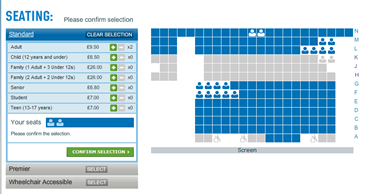
For big cinemas such as Odeon, an online booking system is an effective way of being more convenient and accessible to more customers.  Customers can sign on, select a certain film and a certain viewing and book their tickets instantly. As soon as any booking is made, the information is then updated – so the same seat cannot be booked more than once. You receive your tickets from a machine at the cinema where you enter your payment card number and they are printed out.


The benefits of Online Cinema Bookings
  • There is no need to leave the house and arrive 10/15 minutes before the start of the film
  • When booking online there is the opportunity to pre-book tickets for films that have yet to be released
  • You can immediately see when a film showing is fully booked without having to arrive and then go home or rearrange your plans
  • Once your seat is booked, you have a guaranteed place as no one else can book the same seat
  • Some cinema sites have special ‘points’ offers for people who book online
  • The payment is straightforward and means you don’t have to take any money with you to the cinema, unless you’re buying refreshments

The detriments of Online Cinema Bookings
  • You do not actually receive a ticket – so there is no absolute certainty as something could go wrong
  • Someone can only book online if they have a credit or debit card to pay with – your computer cannot except cash
  • If a customer has booked online there is the automatic expectation of the ‘machine’ that all tickets booked together will be collected together – so you have to collect your tickets as a group at the same time
  • If the ticket machine at the cinema is broken, this may not be advertised on the website so you could book your tickets unaware

My uses of Online Cinema Booking
As I do not have a credit or debit card, I have never personally bought a ticket booked online. I have used my mum’s card to pay for tickets though so have had quite a lot of experience with online cinema booking – especially recently as my mum has become a member of Odeon’s ‘Premiere Club’ which enables her to collect points for every time she buys tickets. I have found booking online really beneficial as it is quick and easy and it reassures me that, even if I’m late, I will still have a seat. There was one incident though, where we’d booked tickets for two separate films that were showing at overlapping times – a pair for one film for me and a friend, and some other tickets for my Mum and Dad to see a different film – and when I picked up my tickets for my film with a friend, the tickets for the other film were printed off too: this caused problems for my parents.  Other than that one occasion, I have had no other problems but have reaped the benefits of pre-booking as it has meant I can assure tickets for high-demand films that I know will sell out quickly once they are released.


Online Flight Booking
You can book tickets for flights online either through specific airlines or with an independent website that could provide lots of flights from a variety or airlines.

The benefits of Online Flight Booking
  • It can be cheaper than booking via high street travel agents as it ‘cuts out the middle man’
  • Booking online allows people to compare prices of different airlines quickly and easily
  • There is no need to leave the house
  • Immediacy
  • You can book tickets online at any time of the day or night

The detriments of Online Flight Booking
  • Unlike with travel agents, there is no one to ask for advice from
  • Some people who find using computers may find booking a flight online confusing and difficult
  • If a booking site is not valid there may be privacy concerns as you have to obviously give away a lot of personal details, including credit card details, online
  • Mistakes may be made in the booking process and they may not be able to be changed online but there could be the possibility of rectification if done with a travel agent
  • There are sometimes additional charges with booking flights online

My uses of Online Flight Booking
My family goes on holiday once every other year, and as I never have the responsibility of booking the tickets I have next to no experience of online flight booking. My Dad always books the tickets online though as he finds it easier and less time consuming. He feels that being able to instantly have a flight booked without having to deal with a travel agent, and from the comfort of your own home makes the sometimes stressful experience a little bit more bearable. 


Tuesday, 13 September 2011

Online Communication

Email (electronic mail)
Emailing is a way of sending messages, and documents, from one computer to another.
The first real Email was sent in 1971 – just 40 years ago. Since then this method of communication has escalated and in 2006 around 22 million Emails were sent everday. Email revolutionised the way people correspond and offered many benefits compared to the traditional alternative of that time – phone calls or letter writing. Many of those advantages are still relevant today.

The benefits of Email
·         Quick – involving just five simple steps (listed above)
·         No need for paper
·         Allows for easy rectification of any mistakes without the need to start over again
·         There is the option to send the same message to many people at once
·         You can send emails from the comfort of your own home, without having to buy stamps or walk to the post-office
·         Availible on any devices with Internet connection, including mobile phones
·         It is fairly cheap
·         Email allows you to send various attachments e.g. pictures, music, videos or documents along with the Email

Emailing however, like most things, is not perfect. There are many disadvantages to this method of communication.

The detriments of Email
·         Both the person sending the Email and the person recieiving it need to be connected to theInternet and have Email
·         The hardware and software sometimes needed can be expensive
·         If a single letter of the Email address is wrong (e.g. sarah@email.com instead of sara@email.com) and the Email won’t be delivered
·         A sent message will just sit in the recievers’ inbox until they check their Emails
·         Damaging viruses can be transferred via Email – Email is the most common way of infecting computers with viruses
·         4 billion spam messages every year are sent (correct 2006)

These things in particular are reasons why nowadays Emailing has become less popular and people are branching out to using more modern, updated alternatives.

My uses of Email
The main way in which I use Email is to send homework documents to my teachers as this saves me from having to print it out at home and remember to bring it in to school. In terms of using Email as a mean of communicating with friends of family on the other hand, I would have to say I do not use it very often as it seems fairly ‘slow’ when compared to other online communication services e.g. instant messaging.  My friends in particular rarely check their email everyday, so if I sent them an email they would probably not be read or responded to immediately – which is where I feel Emailing falls short. I believe that in the future Email shall become less and less popular as it is ‘outshined’ by other messaging methods – however, so long as there are people too confused by the complications new messaging methods can bring, Email will still be used as a straightforward and somewhat more relaxed process of contact.


Instant Messaging – MSN
Instant messaging consists of sending real-time messages to another person or group of people. It is a fast and simple way to chat to friends and family online. With instant messaging, all you need is to be connected to the internet and to set up an account. The main function of all instant messenging services is the open a new method of simple communication. MSN is a particularly well known example of instant messaging.


The benefits of instant messaging
·         You can keep a log of contacts and are alerted to when they are online
·         You can hold multiple ‘live’ conversations at once, with multiple people
·         Most instant messaging conversations, for instance on MSN, allows you to transmit music files and pictures between members
·         Instant messaging programmes – liked MSN – are usually free to download and there are no charges to use it, which means you can spend as long as you want communicating on it

The detriments of Instant Messaging
·         There is a major danger element in terms of paedophiles having access to MSN and being able to talk to anyone who accepts them
·         Bullying can occur quite often over instant messaging, as people are ‘hidden’ behind the screens
·         People with little computer-literacy will take longer to reply and this will make conversation inconsistent, and it may hold them back in terms of using all the applications that the service has to offer

My Use of Instant messaging – MSN
2 or so years ago, I used to use MSN almost every week when at home as it is incredibly easy to use and safe – if you use it properly and don’t accept strangers.  I used to use it just to chat to friends in the evenings and on weekends as it would save me money on my mobile credit, and I would use it to keep in contact with cousins who live abroad. Even though on MSN anyone can get an account, my parents in particular were reassured that you can block and delete contacts so that person can no longer contact you or converse with you. Nowadays however, I do not really use MSN at all as there are other ways that suit me and my needs better. I also feel I have ‘outgrown’ MSN and now use more advanced and sophisticated services – and so do my friends and family. MSN was also becomingly increasing unsafe as it was being used to spread viruses and I would receive a lot of spam from bogus addresses.


Blogs
A blog, also known as a web-log, is a personal diary or journal published on the Internet. Since they were first made in around 1997, well over 5 millions blogs have been made. A blog can be made by anyone and, in terms of personal information, requires only their email address and username.

The benefits of Blogs
·         Photos and links can be included on blogs – this makes them interesting and improves their appearance
·         It is easy to leave Posts and there is the option for others to comment on the Blog – these comments are easy to view and respond to
·         Simple to create
·         Can be made private and seen only by select users
·         Could be used to communicate to lots of people at once
·         Creating a blog is straightforward

The detriments of Blogs
·         Some people reveal too much personal information on their blogs – this could, in extreme cases, lead to major problems like identity theft
·         People owning public blogs are susceptible to bullying

My Uses of Blogs
Personally, before now, I have never created a Blog or browsed many Blogs before. But having created one for this project I have found them simple to set up and can easily see the useful features Blogs have to offer. It is nice not to have limitations of what you can write and the freedom to create a blog for almost anything – and that you can make more than one Blog is you want. I don’t think I would make a personal blog though as I don’t feel comfortable displaying my personal life over the internet.
 Friends of mine have frequently made and updated personal Blogs which allow them to inform long distant family and friends of the latest news within their life, and to display to them picture and video updates too.


Message Boards
Message boards, also known as forums, are online discussion areas. Users can post discussions and read and respond to other people’s posts. Separate conversations within a message board are called threads – made up of posts written by members. Most message boards are based on a particular topic and attracts a sort of ‘online community’ of people who are interested in discussing or reading about that topic.. Message boards can be dated back to around 1994, so is a fairly recent trend. Forums can also be found on a lot of different technologies – an example of this is an computer games – and is used as a place for the players to talk and discuss their gaming and any new tactics or availible updates.

The benefits of Message Boards
·         Before joining an Internet forum, people usually have to agree to a set of online rules (depending on the forum’s settings)
·         Message board administrators can join in threads – as well as modify and delete certain posts or comments. In some cases they can also temporarily block people for breaking the message board’s rules. This would help to prevent bullying and profanity.
·         You can start a board about whatever you want
·         Most message boards are free to join and you can use them whenever you want
·         The non-live discussion can be visited at times convenient to the user, and they can catch up on any posts or comments they have missed
·         There is no need to contribute – you can simply read along with the forum if you don’t have anything to add to the conversation
·         Can be used as good information resources

The detriments of Message Boards
·         Due to the lack of restriction on what the topics for message boards can be, some people use it to express negative thing e.g. self harming forums designed to influence others
·         Similar to blogs and instant messaging, people are more likely to be bullied due to others feeling more confident to say things online than they would face-to-face
·         Anyone and everyone can join and comment on anything

My Uses of Message Boards
I have never really used a message board, but my brothers and sister have. There are various student message boards from people doing the same course as my sister so she can take a look at the opinions and advice of others when she is finding a particular piece of work difficult and she finds it straightforward to comment and communicate through threads. My brothers use the forums availible on their XBOX to talk to their friends about what they are playing and, being fairly technologically-capable they too find it simple to use and a really useful addition to their gaming. I have heard of bad experiences on TV though, of girls joining forums to discuss Anorexia and various methods of ‘staying thin’ unhealthily – without the knowledge of their parents.


Online Video Conferencing
Online video conferencing uses the Internet as a location for conferences. Used mainly by business people, online conferencing can be used in many ways e.g. meetings, lectures or short presentations and can be based on any computer. It allows people to hold visual conversations online at any time – all that is required is an internet connection, a visual input  (e.g. webcam), an audio input (microphone) and an audio output (speakers).

The benefits of Online Video Conferencing
·         Unlike phone calls, sign language can be expressed over Video conferencing
·         Can be used to transfer documents and other files
·         Can be between just two people, or many more can be added for a group conversation
·         Conferences can be accessed from almost anywhere in the world
·         For businesses specifically, online video conferencing saves on travel costs and time
·         Fairly cheap as hardware for video conferencing has had various progresses so the price has stayed low – so it is affordable to a wide proportion of the general public, as well as large businesses
·         Lecturers can use it to teach students all over the world – generates the idea that the future of  Education could be students taught via online lessons

The detriments of Online Video Conferencing
·         Flow of images and audio between the two places depends a lot on the Internet speed – and faster Internet can be quite expensive
·         People can be quite image conscious, so may not feel comfortable talking over a video conference
·         In order to partake in video conferencing people need to invest in a microphone and webcam and speakers

My Uses of Online Video Conferencing
My family is connected to Skype, a type of online video conferencing, which allows us to visually communicate to our family all over the world. I find it a nice alternative to simply messaging them in text as you can see their faces, and if it’s been a long time you can see how different they look, and you can hear their voices and the way they are saying things. My Dad has held a couple of online video conferences for work from home which has been particularly convenient as it enables him to stay at home rather than travel abroad, and essentially is allows him to make a profitable relationship with new clients quickly. Furthermore, he believes it is beneficial as he can give presentations to people all over the world from his work place – where he feels calm, fully prepared and less nervous.


Social Networking Sites – FaceBook
Social networking sites act as an online platform for developing social relations between people of similar interests. One of the most well-known and popular Social Networking Sites, which I myself am a member of, is FaceBook. All you have to do to sign up to FaceBook is enter your name, email address, gender and birthday, and create a password – then you have your own personal profile, you can add other people as friends, exchange messages and upload pictures. When first joining FaceBook, you are given clear instructions on how to work the site – so even those who aren’t confident with computers can manage their own FaceBook page. FaceBook was launched in 2004 and has over 75 million active users – and the site is constantly growing, and becoming updated.

The benefits of Social Networking Sites – FaceBook
·         Anyone can join and they only have to give away very few personal details – although some people don’t feel comfortable entering their birthday, it is necessary so the site can prevent younger users from seeing pages that aren’t suitable
·         Users can search for Friends – by just entering their name into a search bar
·         People can join ‘groups’ set up by their workplace, school or university with people of common interest
·         You can determine the different levels of privacy your page has depending on what you feel comfortable with sharing, and with whom
·         Can be accessed through mobile phones
·         Easy to use and unlimited and costless – so you can spend hours on it without it becoming expensive
·         Share photos with friends easily – but you can select which friends can and cannot see them
·         Offers three different ways of conversing with friends – posting on their profiles, private email or instant messaging
·         You can report any abuse and delete any comments on your profile or pictures that you don’t like
·         When another user requests to become your friend you can see how many ‘mutual friends’ you have, and who they are, so you know whether or not they are a complete stranger and can make your own judgement on whether they are reliable

The detriments of Social Networking Sites – FaceBook
·         You need an email address to sign up
·         The site is constantly being updated and changed which, despite the instructions you are offered whenever there is a new feature, can be confusing and frustrating
·         Social networking can easily become an addiction – especially for younger users
·         Fear of cyber stalking
·         Anyone can join as long as the details they put in are accepted by the site


My Uses of Social Networking Sites
At least once every week I use FaceBook and I find it a really good way of socialising online as it is very easy to talk to friends – as it offers private emails, open posts on each other’s profiles and an imitation instant messaging called ‘FaceBook Chat’. I also enjoy the features of the site such as ‘tagging’ people in photos – which allows them to see any pictures they are in. I never have a problem with ‘odd’ people talking to me via the site as I am careful not to allow anyone who I do not know to view my page. Some of my friends are not as careful and have had unpleasant experiences, but they have sorted their problems by either removing that person as a Friend, or by reporting abuse directly to FaceBook.